

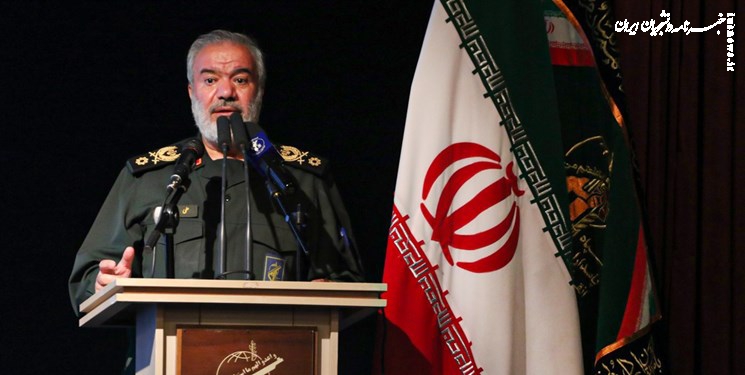
to report «iusnews»; Deputy Commander of the Islamic Revolution Guards Corps (IRGC) Rear Admiral Ali Fadavi stressed that the Palestinian resistance groups now rely on the domestically-developed military equipment to meet their needs for defending their country.
Addressing a gathering of students at Tehran University on Monday, the high-ranking commander said Iran has supported Palestine since the 1979 victory of the Islamic Revolution, but dismissed reports that Tehran has provided the resistance groups with missiles and weapons in the recent war with the Israeli regime.
Rear Admiral Fadavi noted that resistance forces have become independent and have upgraded their military equipment throughout years.
He added that the Palestinian resistance factions’ stand-alone military operation, dubbed “Al-Aqsa Strom”, “left Israelis in shock”.
Fadavi also stated that Israeli regime’s Iron Dome missile defense system has proved once again to be a failure.
Iranian officials have stressed that Tehran emphatically stands in unflinching support of Palestine, but is not involved in the resistance movements’ military operation against Israel.
Tehran has made no secret of its backing for Palestinian resistance movements, Hamas and the Islamic Jihad. Iranian officials have repeatedly stressed the necessity for arming the Palestinians with weapons and equipment to enable them to defend themselves.
READ MORE: Army Chief Dismisses Claims about Iran's Involvement in Hamas Raid on Israel
On October 7, Hamas initiated a multi-pronged surprise military operation via land, sea and air. The group announced it was in response to the storming of Al-Aqsa Mosque in occupied East Jerusalem and Israeli settlers’ growing violence against Palestinians. The attacks have so far killed more than 1,400 and injured over 5,000, according to Israeli officials. Hamas also announced it is holding between at least 200 and 250 hostages.
Following the multi-front attack by Hamas, Israel carried out heavy bombardment across the Gaza Strip, killing more than 5,000 Palestinians, including hundreds of children and women, and wounding over 16,000 others. Tel Aviv has also ordered a "complete siege" of Gaza, saying he would halt its supply of electricity, food, water and fuel.
Israel's relentless bombing of Gaza has damaged half of the besieged enclave's residential units and displaced 70 percent of the population, Palestinian officials have announced on Sunday.
According to the local government's media office, around 165,000 residential units were damaged, with at least 20,000 of them completely destroyed or made unfit for habitation.
Israel’s military has also ordered 1.1 million people living in Northern Gaza to evacuate their homes, amid signs it is set to ramp up its offensive. The bombing, as well as enforced displacement orders by the army, has pushed 1.5 million people out of their homes.
The United Nations has warned it is “impossible for such a movement to take place without devastating humanitarian consequences" as hospitals in the besieged territory are "on the brink of collapse".
Gaza is one of the most densely populated places on Earth, where some 2 million people live in an area of 140 square miles. It has been almost completely cut off from the rest of the world for nearly 17 years. More than half of its population lives in poverty and is food insecure, with nearly 80% of its population relying on humanitarian assistance.
Human rights groups have stressed that depriving an occupied population of basic necessities is a war crime. Palestinian health officials have warned Gaza is rapidly running out of water and electricity, and the population faces severe shortages of food and medicine. They say several hospitals in the besieged territory are under constant bombardment and facing imminent shutdown due to a lack of fuel.
The Gaza Health Ministry has announced at least 10 hospitals in the Gaza Strip have stopped working due to Israeli shelling and fuel shortages, while the regional director of the World Health Organization (WHO) telling Al Jazeera at least 20 out of the 35 hospitals in the coastal enclave are no longer functioning.
Five UN agencies have warned that the humanitarian situation in the Gaza Strip is "catastrophic", calling for more international help as conditions deteriorate in the densely populated besieged enclave.
"Gaza was a desperate humanitarian situation before the most recent hostilities," the UN agencies said in a joint statement on Saturday, adding, "It is now catastrophic. The world must do more."
"More than 1.6 million people in Gaza are in critical need of humanitarian aid," added the statement, which was signed by the World Health Organization (WHO), the UN children's agency (UNICEF), the World Food Program (WFP), the UN development agency (UNDP), and the world body's population fund, UNFPA.
Tehran says the history of the apartheid regime is full of assassinations, massacre, torture and killing of Palestinian kids, and described Tel Aviv regime's atrocities and massacre of Palestinian women and children as indicative of the destitute of Zionists. Iranian officials say the Tel Aviv regime has been struggling for more than 70 years to exit its identity crisis which has been mixed with genocide, plunder, forced displacement and scores of other inhumane moves.
