

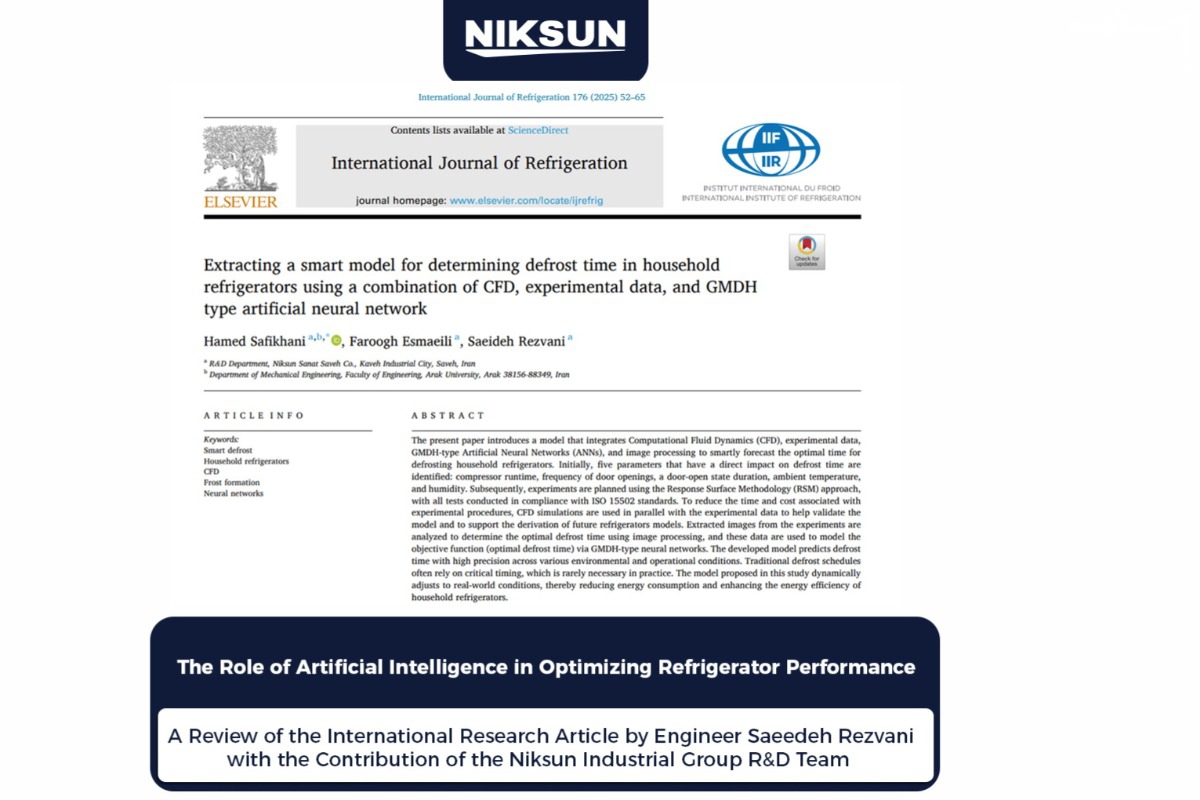
to report «iusnews»; A review of an international research article by Engineer Saeedeh Rezvani from the Niksun R&D Team
In recent years, improving energy efficiency in household appliances has become one of the most important research topics in the refrigeration industry. One of the key challenges in this field is managing the defrost process in household refrigerators. This process removes frost from the evaporator, yet in many appliances it is still performed based on fixed time intervals, which can lead to unnecessary energy consumption.
In this context, Engineer Saeedeh Rezvani, a member of the Research and Development team at Niksun Sanat Saveh, has presented a scientific study proposing an intelligent solution to this issue.
The article, titled:
“Extracting a Smart Model for Determining Defrost Time in Household Refrigerators Using a Combination of CFD, Experimental Data, and GMDH-Type Artificial Neural Network”
was published in 2025 in the International Journal of Refrigeration. This specialized journal focuses on refrigeration systems and is published by Elsevier Ltd in collaboration with the International Institute of Refrigeration (IIR), and is accessible through the ScienceDirect scientific database.
The main objective of this research is the development of a smart model for determining the optimal defrost timing in household refrigerators. In conventional refrigerators, the defrost process is typically performed at predetermined time intervals. However, the actual formation of frost depends on several factors such as ambient temperature, humidity, frequency of door openings, and user behavior. As a result, the defrost process may occur either earlier or later than the optimal time, which can reduce the appliance’s overall energy efficiency.
To address this challenge, the study employs a hybrid methodological approach. First, experimental data from refrigerator operation under real conditions were collected. Then, Computational Fluid Dynamics (CFD) simulations were used to analyze thermal behavior and airflow patterns inside the appliance. Subsequently, the combined experimental and simulation data were used to train a GMDH (Group Method of Data Handling) artificial neural network to develop a predictive model for determining the appropriate defrost timing.
The proposed model can predict the optimal moment for initiating the defrost process by considering several variables, including compressor operating time, frequency of door openings, door open duration, ambient temperature, and relative humidity. The results of the study indicate that employing such intelligent models can significantly reduce energy consumption, improve the thermal performance of refrigerators, and enhance the overall efficiency of cooling systems.
The publication of this research in a reputable international journal in the field of refrigeration highlights the scientific and research capabilities of Iranian specialists in addressing industrial challenges through advanced engineering methods and artificial intelligence. It also reflects the knowledge-driven approach of the Niksun R&D team in developing innovative technologies and improving the performance of household appliances.
The article appears in Volume 176 of the International Journal of Refrigeration, pages 52–65, and is available on ScienceDirect under the digital identifier: DOI: 10.1016/j.ijrefrig.2025.04.016.
