

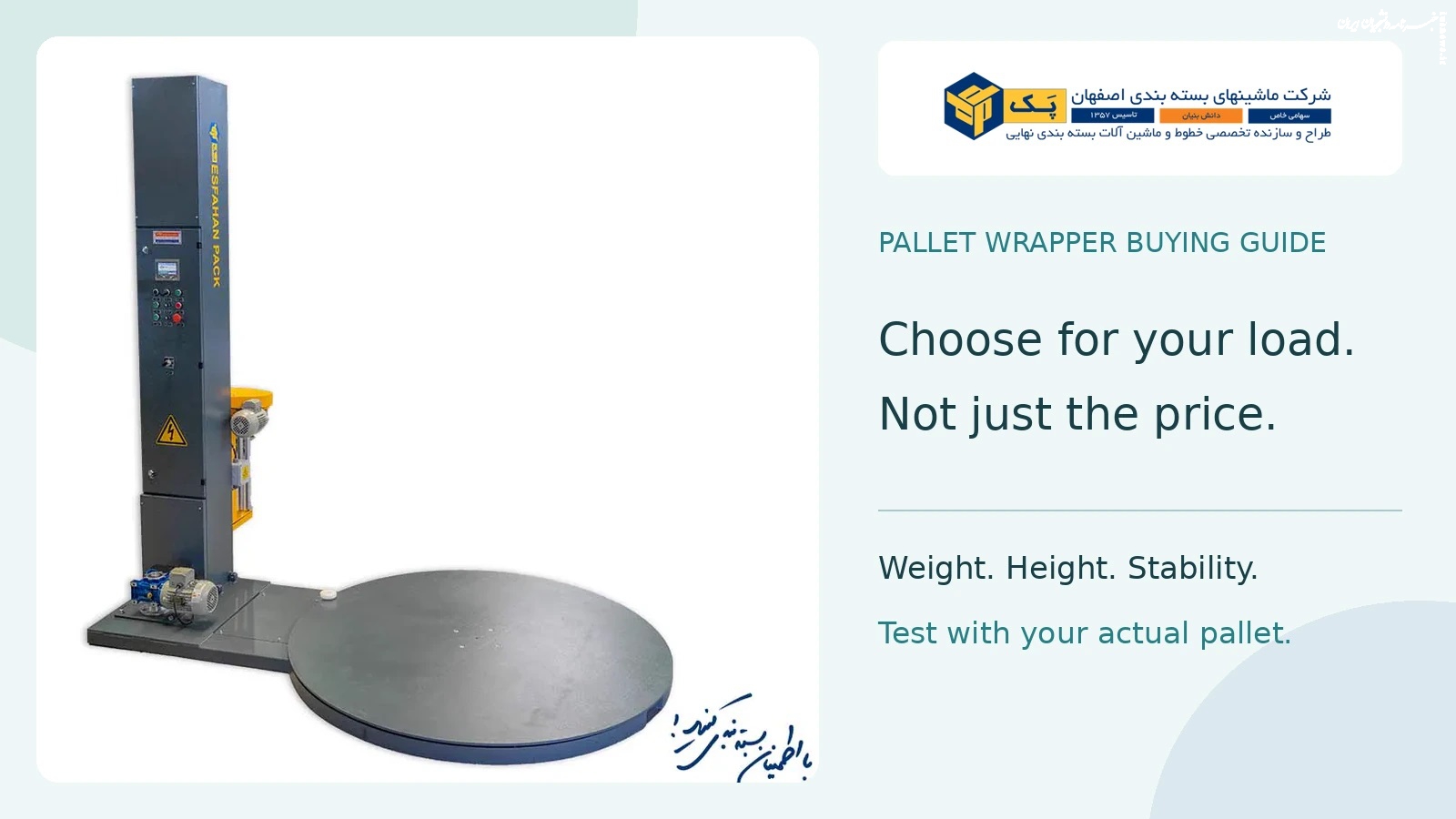
to report «iusnews»;
The right machine should prove itself with your pallet—not just a seller’s demonstration load.
Start with the load you need to secure, then compare machines and prices.Two pallet wrappers can produce similar-looking results while performing very differently in your warehouse. One may handle stable cartons comfortably but struggle with a tall, lightweight stack. Another may wrap quickly yet lose its advantage during loading and unloading.
This pallet wrapper buying guide focuses on the questions that reveal those differences: Can the machine handle your load safely? Does it meet your actual throughput? And can it deliver repeatable wrapping quality without excessive film use or product damage?
Before Requesting a Quote, Define Your Load
Give every supplier the same operating requirements. Include both typical pallets and the most demanding loads you regularly handle.
- Dimensions: pallet length and width, loaded height, and any product overhang.
- Weight: minimum and maximum total pallet weight, including uneven weight distribution.
- Product characteristics: fragile cartons, compressible packs, bags, sharp edges, or unstable stacking.
- Production demand: average pallets per hour, peak demand, and shifts per day.
- Handling method: pallet jack, forklift, or conveyor transfer.
- Dispatch conditions: storage, internal handling, and expected transport demands.
Photographs and representative sample pallets help clarify requirements that a weight-and-height specification cannot capture.
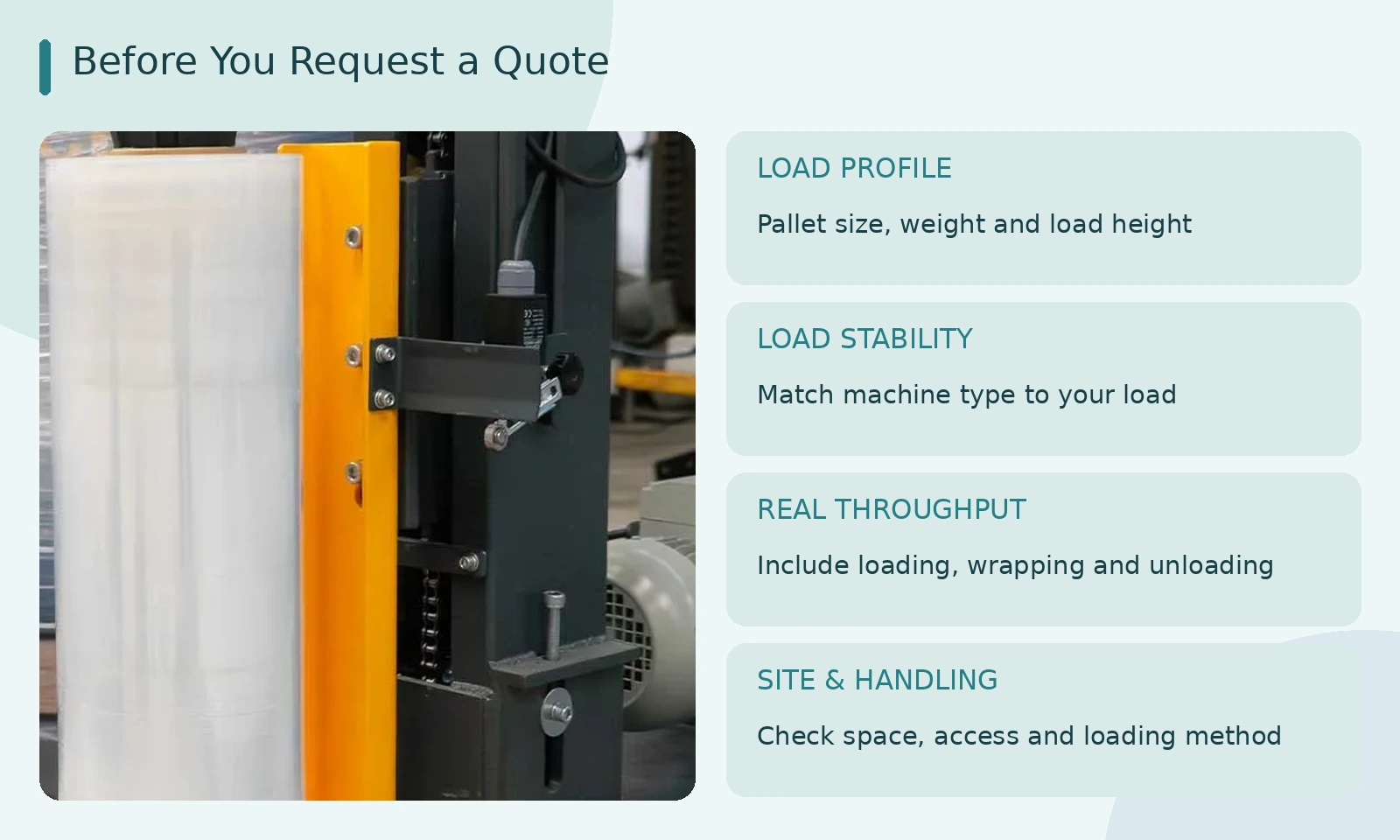 A useful quotation begins with a clear load profile and realistic handling requirements.
Turntable or Rotary Arm Pallet Wrapper?
The key distinction is what moves. A turntable rotates the pallet; a rotary arm moves the film carriage around a stationary load.
When a turntable may suit the application
A turntable wrapper can be suitable for stable loads within its rated weight and dimensional limits. Check platform size, acceleration, loading height, and compatibility with your handling equipment. A top-pressure device may help some applications, but its suitability depends on whether the product can tolerate that pressure.
When a rotary arm deserves consideration
Keeping the pallet stationary can benefit loads that are unstable during rotation or impractical for a particular turntable. However, film forces still act on the goods. Check the arm’s swept area, load clearance, guarding, and supporting floor or conveyor capacity.
For an initial comparison, review the supplier’s turntable pallet wrapper and rotary arm pallet wrapper options. Confirm current specifications and suitability through a product-specific trial rather than assuming either design fits every load.
Measure Real Throughput, Not Just Wrapping Speed
For a standalone machine with sequential handling, the complete cycle includes positioning the pallet, attaching film where required, wrapping, finishing the film, and removing the load.
Theoretical pallets per hour = 3,600 ÷ complete cycle time in seconds. Actual output must also account for film changes, interruptions, and operator availability. On integrated lines with overlapping operations, evaluate the line bottleneck instead of simply adding every operation’s duration.
Ask suppliers to demonstrate sustained output using your required wrap pattern. A fast cycle with insufficient containment is not a valid capacity benchmark.
Pre-Stretch: Compare Film Use at Acceptable Load Stability
A pre-stretch system elongates film before applying it to the load. Powered systems typically use rollers running at different speeds. Pre-stretch can improve film utilization, but the result depends on film compatibility, machine settings, and the load.
Do not confuse pre-stretch with the force applied to the product. A high advertised stretch ratio does not, by itself, prove lower wrapping cost or better containment.
Compare film mass per accepted pallet under documented conditions. Record the film specification, load, settings, film breaks, and rejected wraps. If suppliers use different films, include their actual cost and performance rather than comparing grams alone.
Pre-stretch is worth evaluating when demonstrated savings and consistent quality justify its additional purchase and maintenance costs.
Check Whether Wrapping Settings Match Your Products
Look for useful control over film application force, top and bottom rotations, carriage travel, and layer overlap. Different products may need different recipes: a rigid carton stack and a lightweight, compressible load should not automatically receive identical settings.
During testing, check corner compression, carton movement, film tearing, coverage, and how the load is secured to the pallet. More tension or more layers is not always better. The objective is adequate containment without damaging the goods.
Plan the Installation and Safety Arrangements
Allow space for the machine, its moving envelope, loading approaches, operator access, and maintenance. Confirm floor requirements, utilities, overhead clearance, and separation from pedestrian routes.
If loading by pallet jack, verify the proposed ramp or low-profile arrangement with the actual jack and load. Forklift access also needs adequate maneuvering room.
Ask how moving parts and access points are safeguarded, how emergency stops and any interlocks operate, and how unexpected restart is prevented. An emergency-stop button does not replace suitable guarding. Safety checks and maintenance procedures should be demonstrated by qualified personnel without bypassing protective devices.
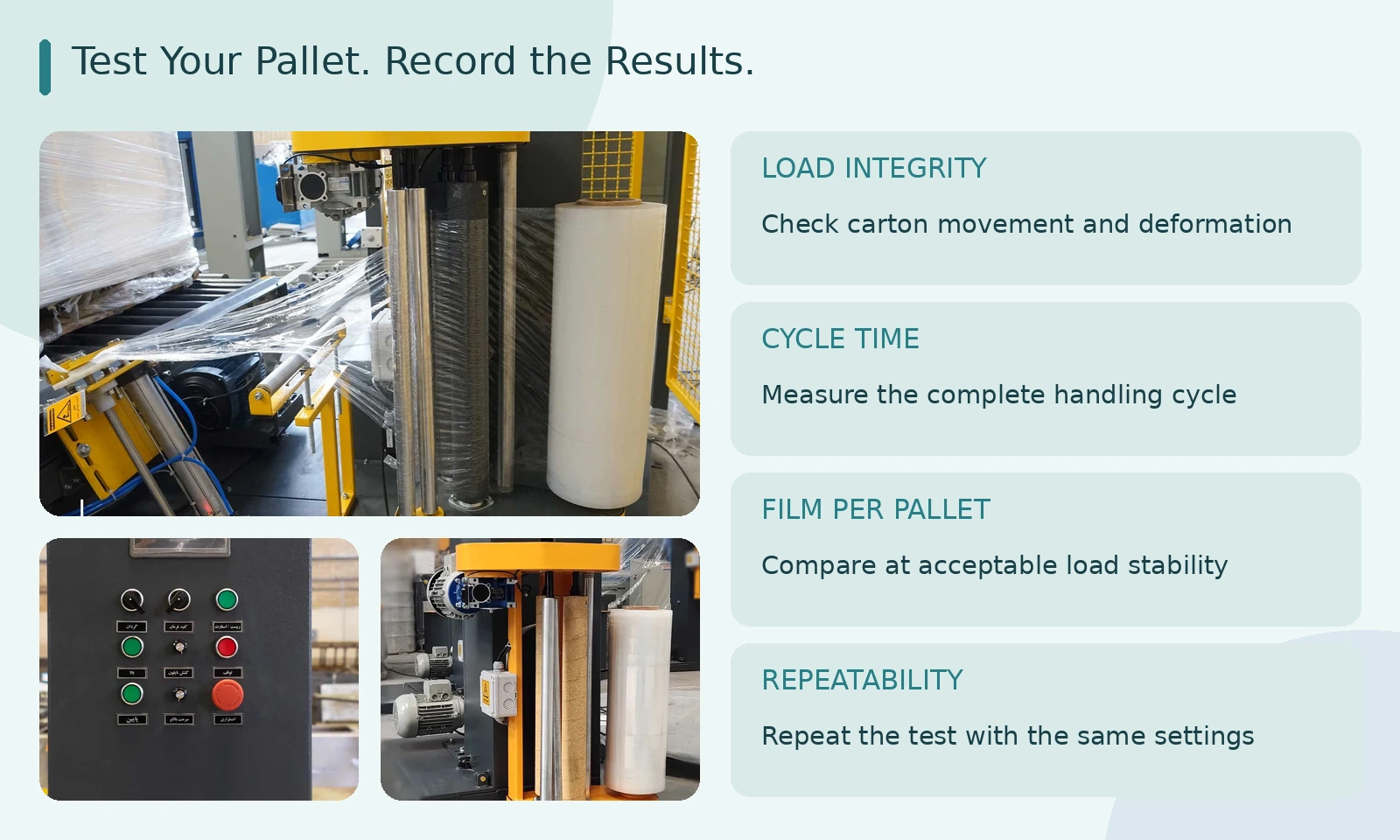 Record measurable results and repeat the trial with the same settings.
Real-Pallet Acceptance Test: What to Record
- Test representative loads. Include your normal pallet and relevant difficult cases, such as tall, light, heavy, or compressible loads.
- Document the setup. Record load dimensions, weight, film specification, and wrapping recipe.
- Measure the complete cycle. Include normal operator tasks and pallet handling.
- Measure film consumption. Use a documented weighing method across several pallets and account for waste.
- Inspect load integrity. Check shifting, leaning, crushed corners, film damage, and loose film tails.
- Repeat the test. Confirm that quality remains consistent without unplanned adjustment.
- Validate handling performance. Use an agreed, safe assessment appropriate to your distribution conditions. Appearance alone does not prove transport stability.
Set acceptance limits before the trial. A successful demonstration should produce a written record, not just a satisfactory-looking pallet.
Use One Table to Compare Supplier Proposals
| Comparison criterion | Supplier A | Supplier B |
|---|---|---|
| Verified load weight, dimensions, and stability range | Record tested limits | Record tested limits |
| Complete cycle time and sustained output | Record measured results | Record measured results |
| Film mass and cost per accepted pallet | Record film and settings | Record film and settings |
| Safety provisions and site requirements | List included provisions | List included provisions |
| Training, spare parts, and service response | Record written commitments | Record written commitments |
Also compare installed cost, warranty exclusions, maintenance requirements, and consumable availability. Ask who provides support and what response times are committed to in writing.
Buy Proven Performance, Not Just a Machine
The best pallet wrapper is the one that fits your load, workflow, and support needs. Before committing, contact Esfahan Pack with your operating requirements and ask about a representative pallet trial. Make verified throughput, acceptable film use, package integrity, and repeatability part of the purchase agreement.
